Although some individuals do volunteer work, for most people money is a universal motivator. However, besides money, there are many additional motivators or reasons why we work and we may not even be completely aware of what motivates us. If you are seeking to develop an encore career, start a small business, begin a senior side hustle, accessing your motivators may help in your decision making and success.
The first time you read this list of motivators and the examples of behaviors common to this motivator, you will probably select five to ten of these 30 motivators as describing you. Reviewing your list again, perhaps reviewing it several times and reviewing your work history and your ideas or dreams for your next potential opportunity, reduce your list to your top five motivators that will be essential in your next endeavor. If you discover that identifying your top five motivators is difficult or confusing, you may want to discuss this exercise with someone who knows you well.
This following list of motivators are not ranked by importance or popularity; they are listed in alphabetical order.
1 Accomplishments
Do you feel proud when you use your education, technical training, experience, or special skills in your work?
Do you feel a sense of completion when you finish a work-related task or project?
Do you like undertaking expert tasks or special projects?
#2 Action
Do you like work assignments that are high risk or give you an adrenaline rush?
Do you enjoy being constantly on the go, living with tight deadlines?
So what if you want to start a part-time business but you don’t really want to do the work of actually starting a business. Maybe you want a business, but you are not sure you have what it takes. You think that you would enjoy selling something that you believed in, but what if you did not?
Consider joining the 15.6 million Americans who have turned to direct selling for part-time income or even as a full-time career. Why is direct selling so popular? Besides providing you with a product and training, surveys indicate that most consultants choose direct selling because it’s uniquely flexible. You can:
be your own boss
set your own hours
work around other priorities such as providing care for children or aging family members
begin with a very limited investment and it is one of the few work ventures where women earn dollar for dollar what men earn
drop out easily, if you discover that it is not for you.
Since direct selling is easy to enter and leave, it is an excellent choice for the halfpreneur that is exploring their options or the reluctant halfpreneurs – those who feel a need to start a business not because they really want to be in business but they need extra cash and/or there is some obstacle to finding another job. For instance, you only want to be in business:
to bring in some extra money to afford a vacation or to pay down some debt
because it is a flexible way of providing income while you care for family members
while you are unemployed, so there will be no gaps on your resume
for something fun to do while you ease into retirement
to meet new and interesting people
If you’re interested in finding a direct selling organization to be a part of, the best places to start are the Direct Selling Association’s website and DirectSelling411.com. http://www.directselling411.com/forms/CompanyFormPublicMembers/ provides information on the companies that sell specific products and services. Direct selling is no longer just cosmetics and vitamins. There are real estate services, educational services, home appliances, telecommunication, craft supplies, and wine – to name a few. But it is important to like the products you’re selling, and find a company that can give you a solid support system for a fast, smooth start.
If you are an over 50 “industry-expert” who is downsized or forced into “retirement” you may be able to turn your knowledge into dollars. Consultants make money from selling what they know. Oh yes, there are plenty of jokes about the increase in the number of consultants when the economy is poor, and yes almost anyone can claim to be a consultant. A good consultant, however, not only knows his or her subject but also has passion and a drive for excellence. Other characteristics a good consultant will possess are:
Business Acumen – understanding how a business operates, what drives decisions, and what make the industry unique.
Pragmatism – looking at solutions from all angles before designing, recommending, or implementing a solution.
Professionalism – committing to the highest standards of ethics, integrity, and confidentiality.
One can consult in almost any subject but the areas in current demand are: Accounting, Advertising, Auditing, Business, Business Writing, Career Counseling, Communications, Computer Consulting, Editorial Services, Executive Search, Gardening, Grant Writing, Human Resources, Insurance, Marketing, Payroll Management, Public Relations, Publishing, Taxes, Writing Services.
If you are indeed qualified by your experience and expertise to be a consultant, some other things to consider before getting out your Rolodex and hanging your sign include asking yourself…..
Are there any certifications or special licensing I will need? In some states professional fund raisers must be registered with the state before beginning your business. The National Society of Fund Raising Executives offers a certification, however it is not required for consultants to have this certification. If you thinking about becoming a computer consultant, regardless of your skills, some potential clients may want to see a collection of Microsoft certifications.
Do I like to network ? Networking is essential to the success of any type of consultant business. Begin building your network of contacts immediately.
Am I organized enough to be a consultant? Not only must you organize the data you collect or are given, you must have excellent time management skills, and an ability to organize your day.
If being the expert and solving a client’s problems is appealing, here are some steps to help you get started.
1. Renew old acquaintances and refresh your recent contacts in your chosen industry. This might even include contacting the company that downsized or “retired” you to see if they use former employees as consultants.
2. Write out your mission statement of what you intend to help your customers achieve with your consulting help. Keep it under 25 words!
3. Go through your files and look for letters of commendation, awards, etc. Contact friendly outsiders who have expressed a willingness to write testimonials in your behalf.
4. Examine any special insurance, bonding, etc. you will need in your chosen field, such as errors and omissions insurance. Find vendors and get cost quotes.
5. Decide on a business name and get a professionally-designed logo. If you are on a tight budget, you can get matching business cards, letterhead, and envelopes through online sites. Consider: Zazzle.com, vistaprint, US.moo.com.
6. Create a website that is simple in construction and professional in appearance. You can customize a template offered by a web hosting company, use software such as Dreamweaver or MS FrontPage, or find a local developer to work with.
7. Decide if you will need a one-page Letter of Agreement or will need an extensive contract to conduct your business. If you will need a formal contract, find a local business attorney to work with.
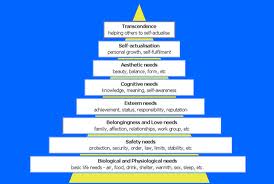
Why do we work? There are many reasons and some psychologists have used Abraham Maslow’s Hierarchy of Needs to explain why we work.
Hierarchy – Maslow
The basic needs, the physiological needs and safety needs, are at the bottom or the pyramid. We work for food, safe housing, medical care, and security. In the middle are our needs for belonging, love, self-identity, and self-esteem. We may not expect to find love in the work force, but we would like respect in addition to feeling that our jobs match our self-identities and enhance our self- esteem. The top level needs are for growth and not survival and might include beauty, justice, self-actualization, and knowledge. According to Maslow we must have the lower level needs met before we can move upward to the higher needs.
During the Agricultural Age and Industrial Age, most people worked to fulfill their basic needs. Work was to pay the bills not to give you identity or self-esteem. With the Information or Postindustrial era, the concept of work changed and we expected our jobs and careers to meet our higher level needs for belonging, self-esteem, and self-identity and maybe knowledge and self-actualization. Only those who lacked an education worked for the basic needs.
The Recession that began in 2008 changed things again. People who once had positions that met their middle and upper level needs now find themselves unhappily working to secure the basics. But the genie will not go back into the bottle. Most of us want our work to be more than supplying our basic needs. There were and are an abundance of books on how to get ahead in the workplace and if that was not working out, there are the books that tell us how to escape from corporate America and start making money by being who you really are. In other words, create a business based on something you feel passionate about.
I teach Self-Assessment and Career Planning as a college course and write resumes. My students and clients primarily want their careers to meet all their needs and provide them with financial security. Oops the long-term financial security is no longer part of the social contract. I also use the Life First – Work Second approach to career planning that comes from Changing Course.com. This coaching method asks what do you want your life to look like, before it asks what kind of work/business do you want to do. It consists of one-three laser coaching sessions to help the client discover how to make money from their passion(s).
Now I am finding passion to be a tricky component of starting a business. Does your business have to be based on a passion? Can it be based on a skill you have or based on a need in the community that you can meet without it being something you are passionate about? What if your passion will not translate into a business of job – you’re passionate about baseball or opera – but you do not have the talent to work in these fields? (Of course, you might have the ability to write about them) What about a passion to do anything that will make a lot of money and give you lots of leisure time? (And there are plenty of websites that promise help you do this)
Life first –work second. What do you want your life to look like? If your leisure time activities are really important to you, you certainly may want a business that provides plenty of leisure time. If your life is your children or grandchildren, then work should allow plenty of time with the kids. Your business may be online, but it does not have to be.
Abel Gonzales Jr. works for24 consecutive days, 15 hours per day at the Texas State Fair, frying up a food that he “invented” – fried butter. You can probably understand how inventing new tasty treats could be a passion, but 24 long days in the heat of Texas! Abel makes enough in these 24 days for the rest of the year. More than 11 months to do whatever else he wants . (From Changing Course –Special Edition9/15/13) If creating new fried food sensations may be your passion, check out what has won prizes at the Texas State Fair. http://www.bigtex.com/sft/Nav/foodinformation.asp
All that leisure time would fulfill the needs of some of us and be a nightmare for others. Assessing or knowing yourself is part of Life first. If you are an Extrovert who gets your energy from being around people or a person for whom work has always given structure to your life, having lots of leisure time will not fulfill your needs. If you are a retiree who wants to start a business or are thinking of starting a business when your retire, there are many things you should consider and your need for structured time and time spent with other people are two of those considerations.
What’s more important? Money? Passion? Leisure? Meeting some need? Using your skills or talents? Let the Halfpreneur know your opinion.
Recently at a lay-lead service at a local Unitarian Universalist church, the lay leader, Don Rawding, gave a sermon on “Change”. After discussing some less than adequate ways of dealing with change such as deny it, lash out at every person, situation and event involved with it, ignore it and hope it will go away, get stubborn and refuse to change, he suggested the best thing to do was FRET: Face reality, Reflect, Evolve, and Thrive.
Job loss and “forced retirement” are changes that many older but not old workers must deal with. Many workers need to have income throughout their 50s and 60s and maybe even into their 70s. Others want to work for a variety of reasons: colleagues, they still enjoy their professional work, their job gives their life meaning, structure. If we have a job at this age we’re advised to keep it since we will see more SSI income if we wait and retire at 70!
Hit with job loss, many do take these less than adequate strategies. “Those higher ups will see their mistake and hire me back in no time.” “It’s all the fault of ______ (fill in the blank).” “I’ll just keep posting resumes on Monster and someone will eventually hire me.” “One of these days my lucky number will come up.”
FRET struck me as a good model for dealing with this change. Face reality. Older workers with great up-to-date, in demand skills do sometimes get new jobs in their fields at pay comparable to their former jobs. But age discrimination is real. Older workers are seen as more expensive, not up-to- date on skills, and 30 and 40 year old managers do not want to hire someone who is the age of their parents! If you want a job, the research suggests that nonprofits are the most likely to hire you, but your skills must still be a good fit.
own your own business
Face Reality – I have a collection of books going back at least 20 years. The advice in almost all these books is that if you lose your job in your late 50s or 60s, start your own business. A few books published between 2004 and 2007 projected that older workers would be needed and ageism would become a thing of the past within a few years because of the smaller generation that is coming along. The authors of these books did not foresee outsourcing, the potential of computers, or the Great Recession.
accomplishments
Reflect – What have you accomplished thus far in your life? What gives you a sense of pride and accomplishment? It does not have to be what you did in the work force? It may be the family you raised or what you have contributed to a church or some other organization. It may be a hardship or a trauma that you have overcome. What skills have you used? Is it important that you continue to exercise these skills? It may be useful to write down your accomplishment s and skills. There is something about seeing things in writing. Is there anything that is unfinished that is still important to complete? Are there areas of life that need to be enlarged? Maybe you were a workaholic and have forgotten what leisure and play feel like!
Evolve – Make some changes in your life. Do you need to develop your computer skills, exercise, lose weight, get training or a certification? Is it time to try something new or go back and enjoy some activity that you have not done in years? You may very well have 20 to 30 years of good health ahead of you.
Thrive – What will happen if you successfully combine the fruits of your reflection and evolving actions.
OOPS – For some individuals, there may be too much of a gap between FRE and T. What if you have no idea what thriving will look like for you? Keep the idea of thriving in mind and add “TING”. Start FRETTING.
sitting meditation
Take Time (the second T) More reflection. Give yourself the time to figure things out. Don’t rush into any decisions. What do you want your life to look like at this point? Where do you want to live? Is it time to downsize to a smaller house? Move to another area of the country or the world. You need or want income, how much do you need or want? How much work time and leisure time do you want? Is there something that you have always wanted to do? Do you have a passion, expertise, talent that can become a new career? Are there problems that you see in your community, your region, your country, the world that you can solve? If you have never figured out what you want to do when you grow up, now is the time! If this is too much to consider on your own, some career counselors, and many life, career, and retirement coaches can help you with your self-assessment.
Innovate. If you do not want to be underemployed, you probably have to consider starting your own business. Consider the problem that you can solve, the service that you can deliver, the craft that you make. What makes it different from the other solutions, services, crafts that are there? How can you make yourself standout? Better service, a more targeted niche? Some type of customization? Check out your competitors on line in and in real time. It is good to have competitors – it means that people are willing to spend money on what you are offering!
Network. Use your virtual and real time connections. There is FaceBook, LinkedIn, and Twitter as well as Blogs. There are the associations and organizations that you belong to in real time. Networking can help you market and sell or get any help you may need.
giving
Give. Give of yourself. Give samples; have a free gift on your website. Let people know who you are. Practice generosity. When you are thriving adopt a charity. Give a percentage of your sales to Trickle Up or a similar organization. According to the psychologist Eric Ericson you are at the psychosocial stage known as generativity, a stage of life characterized by finding meaning through enriching the lives of others. A generative person constantly envisions a better world for themselves, their families, and their society. What do you imagine when you picture the good that will outlive you?
Career experts say it’s much healthier to be continuously thinking about your opportunities rather than waiting for something bad or good to happen. So even though you are happily employed, you’ve begun to start thinking about self-employment or a “working retirement.” Your problem is that you are getting no quick inspirations or ideas. Here are two research ideas to get your brain engaged.
(1) Research your opportunities in your current field – is consultant work available? – Is there a subpopulation that is not being well-served by your industry that you could serve better in your own business? – Is there some business or activity that they could “outsource” to you?
(2) Explore and research new areas of work that interest you. Some fascinating ideas may emerge from some “educational sites” on your computer.
Ed2go.com partners with more than 1800 colleges to offer online courses that can be used in your current line of work or in a new field. Ed2go offers many courses in areas of computers and technology as well as in writing and publishing. It also offers “start-a-new-career” courses including: Pharmacy Technician, Pet sitting, Special Events Coordinator, How to Start an Arts and Crafts Business…..
Fabjob.com sells guide books (~$15.00 – $30.00) on starting specific businesses or entering a new field. More than 100 guides are available including Become a:
Personal Chef Spa Owner
Art Gallery Owner Technical Writer
Dog Day Care Owner Organic Farmer
Genealogist Image Consultant
Doula Brewery Owner
Party Store Owner Funeral Director
Romance Writer Tea Room Owner
Cake Decorator Coffee House Owner
Fitness Club Owner Virtual Assistant
Personal Trainer Web Developer
Life Coach Butler
Real Estate Agent Psychic !!!!!
At the very least, a visit to their website will getting you thinking about all the alternatives you have to not knowing what you want to do, unemployment, underemployment, involuntary retirement, failed retirement, retirement, or just not having enough money.
OpenCourseWare (OCW) is a free and open digital publication of high quality university level educational materials. These materials are organized as courses, and often include course planning materials and evaluation tools as well as thematic content.
OpenCourseWare are free and openly licensed, accessible to anyone, anytime via the internet. Whatever you may want to learn or train for, there is probably a site on line that provides you with online training or gives information on where you can obtain such training. The consortium currently consists of 62 institutions offering 5,737 courses. A number of other institutions offer open courseware but are not part of this consortium including Harvard University and University of Massachusetts, Boston.
If learning online or from a book is not your learning style. Go online and look into what your community college is offering. Besides courses leading to certificates and Associate degrees, many community colleges offer noncredit courses that can prepare you starting your own business.
Online exploration and research is one way of discovering new options. More ideas for discovering your “perfect” part-time biz will be the focus of future posts.