Tag: Employment

  • Why Do We Work? Why Do We Start Businesses?

    Why do we work?   There are many reasons and some psychologists have used Abraham Maslow’s Hierarchy of Needs to explain why we work.  
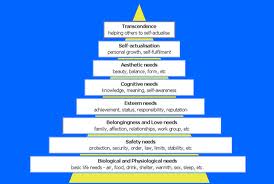
    Hierarchy - Maslow
    Hierarchy – Maslow

    The basic needs, the physiological needs and safety needs, are at the bottom or the pyramid.  We work for food, safe housing, medical care, and security.  In the middle are our needs for belonging, love, self-identity, and self-esteem.  We may not expect to find love in the work force, but we would like respect in addition to feeling that our jobs match our self-identities and enhance our self- esteem.  The top level needs are for growth and not survival and might include beauty, justice, self-actualization, and knowledge.  According to Maslow we must have the lower level needs met before we can move upward to the higher needs.

     During the Agricultural Age and Industrial Age, most people worked to fulfill their basic needs.  Work was to pay the bills not to give you identity or self-esteem.  With the Information or Postindustrial era, the concept of work changed and we expected our jobs and careers to meet our higher level needs for belonging, self-esteem, and self-identity and maybe knowledge and self-actualization.  Only those who lacked an education worked for the basic needs.

     The Recession that began in 2008 changed things again.  People who once had positions that met their middle and upper level needs now find themselves unhappily working to secure the basics.  But the genie will not go back into the bottle.  Most of us want our work to be more than supplying our basic needs.  There were and are an abundance of books on how to get ahead in the workplace and if that  was not working out, there are the books that tell us how to escape from corporate America and start making money by being who you really are.  In other words, create a business based on something you feel passionate about.

    I teach Self-Assessment and Career Planning as a college course and write resumes.  My students and clients primarily want their careers to meet all their needs and provide them with financial security.  Oops the long-term financial security is no longer part of the social contract.  I also use the Life First – Work Second approach to career planning  that comes from Changing Course.com.  This coaching method asks what do you want your life to look like, before it asks what kind of work/business do you want to do.  It consists of one-three laser coaching sessions to help the client discover how to make money from their passion(s).

    Now I am finding passion to be a tricky component of starting a business.  Does your business have to be based on a passion?  Can it be based on a skill you have or based on a need in the community that you can meet without it being something you are passionate about?  What if your passion will not translate into a business of job – you’re passionate about baseball or opera – but you do not have the talent to work in these fields? (Of course, you might have the ability to write about them)  What about a passion to do anything that will make a lot of money and give you lots of leisure time?  (And there are plenty of websites that promise help you do this)

    Life first –work second.  What do you want your life to look like?  If your leisure time activities are really important to you, you certainly may want a business that provides plenty of leisure time.  If your life is your children  or grandchildren, then work should allow plenty of time with the kids.   Your business may be online, but it does not have to be. 

    Abel Gonzales Jr. works for24 consecutive days, 15 hours per day at the Texas State Fair, frying up a food that he “invented” – fried butter.  You can probably understand how inventing new tasty treats could be a passion, but 24 long days in the heat of Texas!  Abel makes enough in these 24 days for the rest of the year.  More than 11 months to do whatever else he wants .  (From Changing Course –Special Edition 9/15/13)   If creating new fried food sensations may be your passion, check out what has won prizes at the Texas State Fair.  http://www.bigtex.com/sft/Nav/foodinformation.asp

    All that leisure time would fulfill the needs of some of us and be a nightmare for others.   Assessing or knowing yourself is part of Life first.  If you are an Extrovert who gets your energy from being around people or  a person for whom work has always given structure to your life, having lots of leisure time will not fulfill your needs.  If you are a retiree who wants to start a business or are thinking of starting a business when your retire, there are many things you should consider and your need for structured time and time spent with other people are two of those considerations.

    What’s more important?  Money?  Passion?  Leisure?  Meeting some need?  Using your skills or talents?  Let the Halfpreneur know your opinion.

  • The Benefits of Self-Employment

    In addition to the extra money, there are other potential benefits to part-time and full-time self-employment.

    •  Meet interesting people.  Usually your business takes you out into the world or brings interesting people into your office that you never would have met any other way.
    •  Life-long learning.  Learning is valued when you work for yourself.  You get to decide what formal and informal learning is necessary for your success.
    •  Ongoing personal growth.  Your business will encourage you to keep growing and discovering new talents and wisdom.
    •  Talent management.   Self-discovery leads to finding your greatest assets and making the most of them.
    •  Keep your imagination.   You can continue to use your imagination and be rewarded for it.  Your creativity will not just be useful it may be absolutely essential.
    •  Better mental health.  The research clearly shows that problem solving is better for you than complaining about things.
    •  Longevity.  Ongoing research is showing that self discovery, using our skills and talents, solving problems, and staying active especially if combined with less stress and less fast food often leads to a longer, healthier, life.
    •  Learn personal responsibility.  If your parents or teachers did not teach you this essential lesson, a business will.
    •  Be a positive role model.  If you follow your dreams, you set an example to your children and others.  They make take inspiration from you without ever realizing it.
    •  Live your passion and purpose.  People want to be appreciated, useful, and know that their lives have meaning.  Discovering your passion is often a prelude to finding your purpose.   A life inspired by purpose means you have discovered what truly matters to you, makes you authentically happy, and allows you to serve others in great and small ways.
  • Job Loss After Age 50 – FRET or Start FRETTING

    change
    change

    Recently at a lay-lead service at a local Unitarian Universalist church, the lay leader, Don Rawding, gave a sermon on  “Change”.  After discussing some less than adequate ways of dealing with change such as deny it, lash out at every person, situation and event involved with it, ignore it and hope it will go away, get stubborn and refuse to change, he suggested the best thing to do was FRET: Face reality, Reflect, Evolve, and Thrive.

    Job loss and “forced retirement” are changes that many older but not old workers must deal with.  Many workers need to have income throughout their 50s and 60s and maybe even into their 70s.  Others want to work for a variety of reasons:  colleagues, they still enjoy their professional work, their job gives their life meaning, structure.  If we have a job at this age we’re advised to keep it since we will see more SSI income if we wait and retire at 70!

    Hit with job loss, many do take these less than adequate strategies.   “Those higher ups will see their mistake and hire me back in no time.”  “It’s all the fault of ______ (fill in the blank).”  “I’ll just keep posting resumes on Monster and someone will eventually hire me.”  “One of these days my lucky number will come up.” 

    FRET struck me as a good model for dealing with this change.  Face reality.  Older workers with great up-to-date, in demand skills do sometimes get new jobs in their fields at pay comparable to their former jobs.  But age discrimination is real.  Older workers are seen as more expensive, not up-to- date on skills, and 30 and 40 year old managers do not want to hire someone who is the age of their parents!  If you want a job, the research suggests that nonprofits are the most likely to hire you, but your skills must still be a good fit.

    own your own business
    own your own business

    Face Reality – I have a collection of books going back at least 20 years.  The advice in almost all these books is that  if you lose your job in your late 50s or 60s, start your own business.   A few books published between 2004 and 2007 projected  that older workers would be needed and ageism would become a thing of the past within a few years because of the smaller generation that is coming along.  The authors of these books did not foresee outsourcing, the potential of computers, or the Great Recession.

    accomplishments
    accomplishments

    Reflect –  What have you accomplished thus far in your life?  What gives you a sense of pride and accomplishment?  It does not have to be what you did in the work force?  It may be the family you raised or what you have contributed to a church or some other organization. It may be a hardship or a trauma that you have overcome.  What skills have you used?  Is it important that you continue to exercise these skills?  It may be useful to write down your accomplishment s and skills.  There is something about seeing things in writing.  Is there anything that is unfinished that is still important to complete?   Are there areas of life that need to be enlarged?  Maybe you were a workaholic and have forgotten what leisure and play feel like!

    Evolve –  Make some changes in your life.  Do you need to develop your computer skills, exercise, lose weight,  get training or a certification?  Is it time to try something new or go back and enjoy some activity that you have not done in years?   You may very well have 20 to 30 years of good health ahead of you.

    Thrive –  What will happen if you successfully combine the fruits of your reflection and evolving actions.

    OOPS –  For some individuals, there may be too much of a gap between  FRE and T. What if you have no idea what thriving will look like for you?   Keep the idea of thriving in mind and add “TING”.  Start FRETTING.

    sitting meditation
    sitting meditation

    Take Time (the second T)  More reflection.  Give yourself the time to figure things out.  Don’t rush into any decisions.   What do you want your life to look like at this point?    Where do you want to live?  Is it time to downsize to a smaller house?  Move to another area of the country or the world.   You need or want income, how much do you need or want?   How much work time and leisure time do you want?  Is there something that you have always wanted to do?  Do you have a passion, expertise, talent that can become a new career?   Are there problems that you see in your community, your region, your country, the world that you can solve?   If you have never figured out what you want to do when you grow up, now is the time!   If this is too much to consider on your own, some career counselors, and many life, career, and retirement coaches can help you with your self-assessment.

    Innovate. If you do not want to be underemployed, you probably have to consider starting your own business.  Consider the problem that you can solve, the service that you can deliver, the craft that you make.  What makes it different from the other solutions, services, crafts that are there?    How can you make yourself standout?  Better service, a more targeted niche?  Some type of customization?   Check out your competitors on line in and in real time.   It is good to have competitors – it means that people are willing to spend money on what you are offering!

    Network.  Use your virtual and real time connections.  There is FaceBook, LinkedIn, and Twitter as well as Blogs.  There are the associations and organizations that you belong to in real time.   Networking can help you market and sell or get any help you may need.

    giving
    giving

    Give.   Give of yourself.  Give samples; have a free gift on your website.  Let people know who you are. Practice generosity. When you are thriving adopt a charity.  Give a percentage of your sales to Trickle Up or a similar organization.  According to the psychologist Eric Ericson you are at the psychosocial stage known as generativity, a stage of life characterized by finding meaning through enriching the lives of others.  A generative person constantly envisions a better world for themselves, their families, and their society.  What do you imagine when you picture the good that will outlive you?

    What Do You Imagine?
    What Do You Imagine?
  • Entrepreneurial Ideas for Boomers and Others

    In my last post, I mentioned that one thing that the Boomers had not questioned was the concept of work and employment.

    This is perhaps because during the last 60 years, we have transitioned from the Industrial or Manufacturing Age into the Post Industrial or Information Age. The industrial world of their parents and the one they might have entered was not the demanding, dangerous Industrial Age but the end of the era when many workers had secure jobs for their entire work lives.

    A job in this not so long ago age, was defined as continuous long-term employment with an organization that provided a regular salary, health benefits, a pension plan and the assurance of a continuing need for the worker’s skills.  This relationship between employers and individuals was called “the social contract.”  Basically it meant that an employer in return for the good service and productivity of an employee, offered lifetime employment with an inherent potential for promotion, regular increases in salary, a good fringe benefit plan and an assured retirement package.  It was a given that the organization that offered employment was stable and would be around “forever.”

    Since the 1980s corporate America has dramatically altered the context of work and the “social contract” is a relationship of the past.  The Information Age (or PostIndustrial Age)  is defined by the ease and rapidity of worldwide communication. Wireless communication, computer networks, the World Wide Web make almost instantaneous communication possible. 

    Manufacturing still occurs even in the US, but it is driven by computer technologies including robotics and nanotechnologies.  The stability and long-term endurance of companies is no longer a given.  Even profitable, highly regarded organizations can be sold or merged.

    If you are over 50, you may remember the “olden days.”  If you are over 60, you may have begun your work life expecting the continuance of the “social contract” or a hybrid version of it where employers honored the “social contract” but employees, especially early in their careers, would change jobs several times before settling into a good job and a good company.

    So we are now in the 21st century looking for meaning in our work in a work world characterized by: a reduced workforce due to downsizing,  a reduced workforce due to outsourcing,  a reduced workforce due to automation and robotization,  increased customization,  increased hiring of temporary employees,  a increasingly diverse workforce,  globalization,  fewer corporations, long-distance collaboration, an emphasis of skills not job titles, and an increased need for continuing education.

    As Stephen R. Covey describes it …..

    “We live in a new economy that is moving from the Industrial Age, top-down, command-and-control, hierarchical model to the Knowledge Worker Age of empowerment and courage and creativity.  We also live at a difficult recessionary time, but that does not mean we a fundamentally a product of our environment.  We are not victims of circumstances.  We are the creative force of our own lives.

    Unfortunately I do not think most of us were raised to think creatively about the economy and the role that we play in the economy.  I sense a longing in many of my clients for the so-called good old days when everyone knew where they fit-in in often paternalistic corporations.  In an evolving, creative, empowering, what are we supposed to do era, what are our new roles?  Will we hold a job or be an entrepreneur or some combination of both?”

    With a job loss after age 50, an individual can wait and hope that they will find employment in their field.  Many become underemployed taking jobs in retail and telemarketing, Some cannot find work and live off their savings and spouse’s income.  Some enthusiastically become the entrepreneurs they always wanted to be while others reluctantly begin to look at their entrepreneurial options.

    By age 50, your employment, your leisure time, and your everyday life have given you a wide variety of skills and expertise.  To identify potential areas of self-employments, I would interview a reluctant entrepreneur about their skills and expertise.

    Here are some questions I might put to them if they are searching for business ideas and a niche.

    1. What opportunities in the market place did you last employer seem to be missing?              EG:  parts for older models,  refurbishing equipment, custom orders
    2. What skills can you sell as a freelancer?                                                                                                   EG:  project management, website design, accounting,  computer                                     programming   
    3. Do you have the knowledge and experience to buy out an existing business?                           EG:  gift shop, home security installation, photography studio, print                                framing shop        
    4. Do you have a manual skill that others would pay for?                                                                       EG:  laminate and hardwood floor installation, stained glass design and                         installation, bricklaying         
    5. Do you have a hobby product you can offer as a business?                                                               EG:  knit goods, jewelry, customized wooden signs, Christmas decorations 
    6. Do you have friends who rave about your cooking or baking?                                                        EG:  ethnic deserts, chocolate specialties, wedding cakes, catering for small                  groups, pre-cooked meals              
    7. Can you sell your talent in a sport?                                                                                                             EG:  canoeing/kayaking trips, running soccer or tennis camps      
    8. Do you possess talent in graphic or fine arts design?                                                                           EG:  Designing websites, designing logos, custom painting clothing or shoes.
    9. Is there a service you need personally but cannot find?                                                                      EG:  taking children to after school activities, driving elderly relatives to                        doctor’s appointments,  locating pieces of silverware or china           
    10. Can you provide a product or service your friends can’t find?                                                           EG:  pet sitter, home delivery of live seafood, genealogical research       
    11. Do you do something as a volunteer that others would pay for?                                                      EG:  teach ESL, transport elderly shopping or to medical visits, visit elder                      who are home-bound                                       
    12. Do you have experience in importing or exporting?                                                                               EG:  used machinery to India and other countries, scientific equipment to                  Eastern Europe, craft items from Africa, Asia, Central and South America   
    13. What knowledge do you have that you can put into a special report or book?                            EG:  internet marketing, raising a child with ADHD, foreign travel with                         children                                                          
    14. Are you experienced and talented in teaching or training?                                                               EG:  English or foreign languages, music, job social skills, negotiation and                   mediation                                                        
    15. Do you have experience in “New Age” disciplines or alternative health practices?                    EG:  Tapping (EFT), Reiki, Reflexology, Fung Shui, card reading, past life                    regression analysis


  • Regular Employment, Self-Employment or Both?

    For most of our past history (1945 – 1995) “regular” employment, working for someone and getting a paycheck and benefits has been the norm for most American workers.  Since the 1990s this “regular” employment has been slowly fading, to the chagrin of many whose first work value is security.  Dan Lacey predicted the decline of steady employment in The Paycheck Disruption, 1990 and Cliff Hakim’s book We Are All Self-Employed, 2003, stated the need for Americans to reassess their place in the marketplace.  William Bridges predicted both the fading of steady employment in JobShift, 1994, and that each individual was his or her own enterprise, Creating You and Co., 1998.

    So whether or not you start a business,  every working person today has to regard themselves as self-employed.  Working for a salary is renting your skills; we are all temporary employees.  Over the past 15-20 years, more and more individuals have started small businesses as either primary or secondary forms of income.

    If you are thinking about starting your own business, you are not only in sync with a number of authors but also in sync with an old tradition and with some of the past leaders of our nation.

    Colonial Stores, picture image
    Colonial Stores

    The more people who own little businesses of their own, the safer our country will be … for the people who have a stake in their country and their community are its best citizens.     —–   John Hancock


    The prudent, penniless beginner in the world labors for wages for a while, saves a surplus with which to buy tools or land for himself, then labors on his own account for another while, and at length hires another new beginner to help him.  This … is …the just, and generous, and prosperous system, which opens the way to all, gives hope to all.  ——  Abraham Lincoln  —-  “Annual Address before the Wisconsin Agricultural Society”


    American Flags, picture image
    American Flags


    Happy 4th of July!