So what if you want to start a part-time business but you don’t really want to do the work of actually starting a business. Maybe you want a business, but you are not sure you have what it takes. You think that you would enjoy selling something that you believed in, but what if you did not?
Consider joining the 15.6 million Americans who have turned to direct selling for part-time income or even as a full-time career. Why is direct selling so popular? Besides providing you with a product and training, surveys indicate that most consultants choose direct selling because it’s uniquely flexible. You can:
be your own boss
set your own hours
work around other priorities such as providing care for children or aging family members
begin with a very limited investment and it is one of the few work ventures where women earn dollar for dollar what men earn
drop out easily, if you discover that it is not for you.
Since direct selling is easy to enter and leave, it is an excellent choice for the halfpreneur that is exploring their options or the reluctant halfpreneurs – those who feel a need to start a business not because they really want to be in business but they need extra cash and/or there is some obstacle to finding another job. For instance, you only want to be in business:
to bring in some extra money to afford a vacation or to pay down some debt
because it is a flexible way of providing income while you care for family members
while you are unemployed, so there will be no gaps on your resume
for something fun to do while you ease into retirement
to meet new and interesting people
If you’re interested in finding a direct selling organization to be a part of, the best places to start are the Direct Selling Association’s website and DirectSelling411.com. http://www.directselling411.com/forms/CompanyFormPublicMembers/ provides information on the companies that sell specific products and services. Direct selling is no longer just cosmetics and vitamins. There are real estate services, educational services, home appliances, telecommunication, craft supplies, and wine – to name a few. But it is important to like the products you’re selling, and find a company that can give you a solid support system for a fast, smooth start.
Is it necessary to have a degree to start a business? No. And contrary to popular opinion, a fulfilling career is also quite possible without a degree. The issue is that we have become a credentialed society and many people believe that a BA is essential to achieving a middle class standard of living. Until very recently, having a four year degree usually ensured higher earnings during one’s working life. With the “college bubble”* this idea is being questioned. Still, parents and guidance counselors urge high school students to go to college. Two out of every three high school graduates will enroll in college right out of high school, but only 30.7 percent of them will have a four year degree by their mid-twenties.
Going straight to college may not be a good idea if:
You are burned out before even starting college.
You received average grades but are not really interested in academics and don’t see yourself excelling n college.
You are only going to college to figure out what you want to be when you grow up.
Finances are a problem and you or your parents will be taking on huge loans to fund your education.
A four-year degree is not necessary for many jobs, neither is a degree necessary for starting a small business. For some careers and some types of self-employment you do need the credentials. You cannot claim to be an accountant or a counselor without the appropriate degree. A career or a part-time business may require some training: on-the-job, mentoring, certificate, apprenticeship or an associate’s degree. The weekend dog groomer or fitness consultant will need some training before setting up their business. Does this mean you can be a halfpreneur while attending college or even start your own business right out of high school? Yes!
Now, I am not opposed to going to college. College teaching is a major part of my halfpreneurial career. I am a part-time instructor at three different colleges: a community college, a private college that specializes in business education, and a state university. There are excellent reasons to attend college and if finances are tight, community and state colleges and universities are often a good deal. However, there are still those individuals who are not interested in or ready for college, but have a passion, talents, or skills that they want to use. For these individuals starting a business may be the way to go.
I would strongly recommend that the young entrepreneur or any potential entrepreneur take some classes, even if they do not get a degree. My short list of recommended courses includes:
English 101 and 102 – writing skills are essential in business.
Public Speaking – you will be talking to people – can you persuade, convince, educate?
Basic computer skills – Word, Access, Excel, PowerPoint, html.
Accounting and Business – Introduction to Business, Marketing, Advertising, Business Law.
Applied Arts – Digital photography, graphic arts, and web design may be helpful.
Foreign languages – Spanish, Chinese, any other language used by a large number of people in your community.
Courses in any program relevant to what you want to do – Criminal Justice, Hotel Management, Education, Holistic Health, Fine Arts, Communication.
Self Assessment and Career Planning – helps students of any age figure out what they what to be when they grow up.
With or without degrees, entrepreneurs are usually life-long learners, so you might as well get started at a community college or in a program that provides certification in your field of interest.
If you want to be a halfpreneur or full time entrepreneur, there are advantages to stretching your entrepreneurial wings while still young – you may still be living at home, have little or no debt, and no family obligations.
What about “paying your dues” and having a job first so you develop a work ethic? Anyone who wants to start a business will need a work ethic, as well as reliability, academic skills and the “job” skills to succeed against the odds facing a beginning entrepreneur. As for the would- be- entrepreneur, a first job is great if it is teaching you the skills you will need to start your business.
What types of businesses can you or any other potential entrepreneur consider? Pay attention, this video has 101 suggestions.
If you are not sure of what you want to be when you grow up but you think you might like to own your own business, check out Profiting from Your Passions Coaching, the Services tab on this page OR take the Self Directed Search www.self-directed-search.com. The SDS is psychometrically sound career test that more than 35 million people have used. It is suitable for high school students through bored retirees. The cost is $4.95 and you get results sent to your email almost instantly. If you would like to discuss how your results match up with self-employment, call me or send me an email to set up an appointment.
*The College Bubble
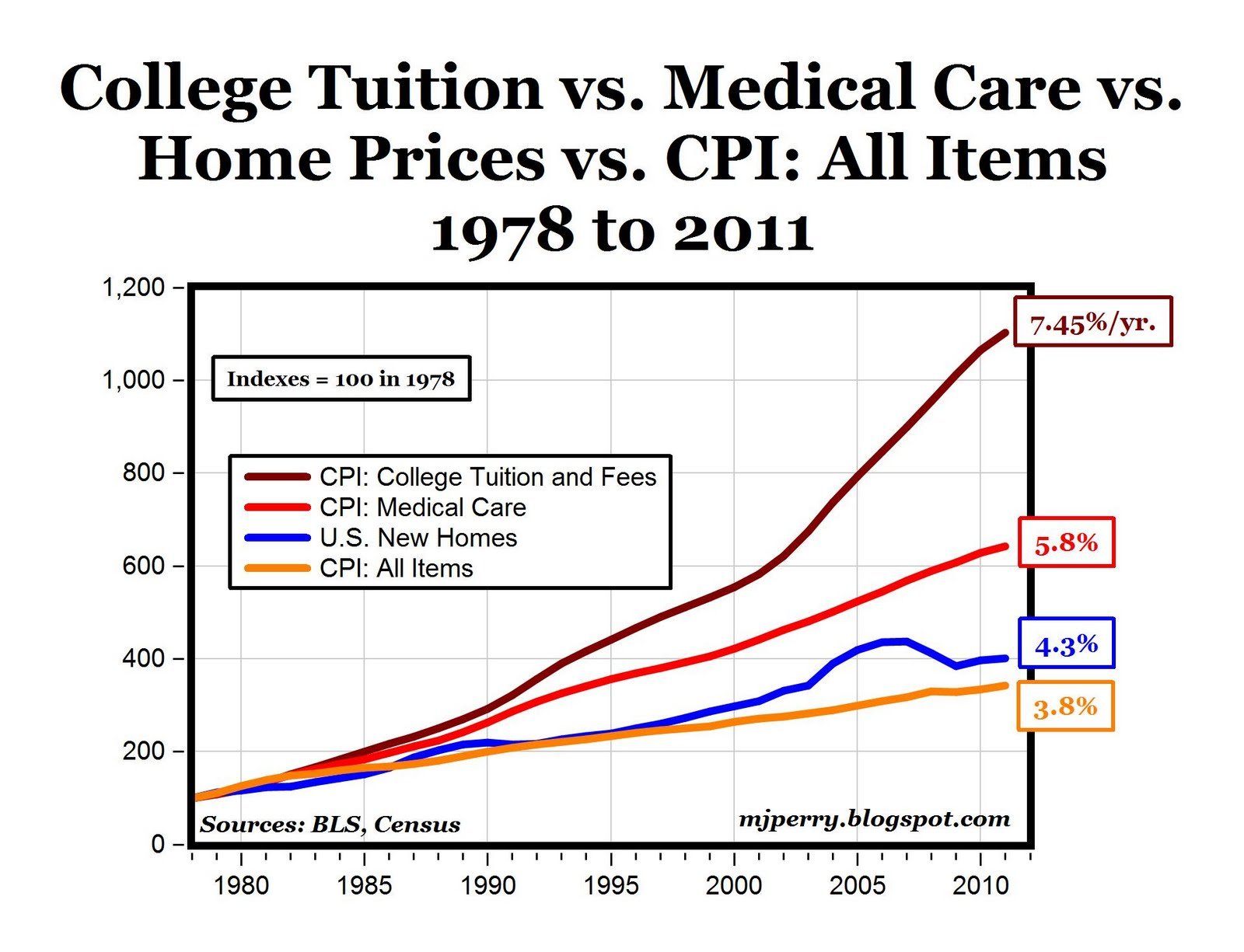
There is controversy over the existence of the College Bubble. Is it a Bubble that can burst like the housing market did or should the problem should be given some other name? Students are taking on “good debt” for their education that will enable to make more money later, but many students now have high debt and several years out of college they are not finding positions that pay enough for their loans, housing, a car, etc. 85 percent of college graduates now return home after graduation because they cannot find a job. Most of these individuals will eventually find jobs and some will discover that there are plenty of positions in their field provided they are willing to move hundreds of miles away to areas with lower standard of living and less pay than they were expecting.
Research indicates that the price of college tuition has increased more quickly than housing and medical care in recent years. Check out this chart from AEI’s Mark Perry showing the rising cost of tuition outpacing basically every other good in American society for nearly two decades: